
Transformational Leadership: Leading from Beyond?
The Organizational Description Questionnaire (ODQ)
The Organizational Description Questionnaire (ODQ) was developed by Professors Bernard Bass and Bruce Avolio to complement their study of what they call the full range of leadership. The full range of leadership looks at organisational culture in relation to transactional and transformational leadership styles. Professor Ken Parry has conducted extensive research on the Organizational Description Questionnaire (ODQ) and it has been shown to be a statistically valid tool for assessing an organisations culture.
It is a brief 28-item questionnaire and the resulting report assist members of an organization explore the relationships between leaders. The Organizational Description Questionnaire (ODQ) measures how often each member of the organization perceives the culture of their unit/department/organization to be using a full range of specific leadership factors. Using transformational and transactional leadership behaviours, the ODQ places the organization on a nine point scale spanning cultures such as "Bureaucratic," "Coasting" and "Highly Developed."
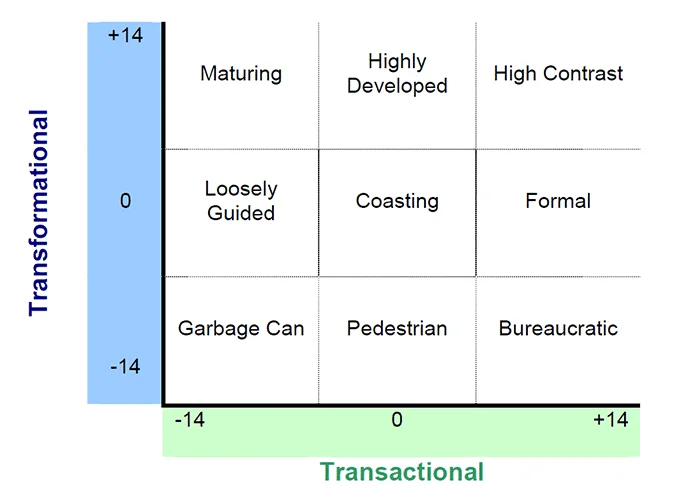 The Organizational Description Questionnaire (ODQ) is a tool used to assess and measure various aspects of organizational development within a company or institution. It aims to gather data and insights regarding the organization's structures, processes, culture, and effectiveness. The questionnaire typically consists of a set of questions or statements that respondents rate or respond to, providing valuable information for assessing the organization's strengths, weaknesses, and areas for improvement.
Key Features and Components of the Organizational Description Questionnaire
| 1. | Organizational Structure The Organizational Description Questionnaire (ODQ) may include questions about the organization's formal structure, hierarchy, reporting lines, and decision-making processes. It seeks to assess the clarity and effectiveness of the organizational structure in supporting communication, coordination, and accountability. |
| 2. | Leadership and Management This section explores leadership styles, managerial practices, and the overall effectiveness of leaders within the organization. It assesses aspects such as communication, employee empowerment, decision-making, and the ability of leaders to inspire and motivate their teams. |
| 3. | Employee Engagement The questionnaire may include items related to employee engagement, satisfaction, and involvement. It aims to measure the level of employee commitment, job satisfaction, and the extent to which employees feel valued and included in organizational processes and decision-making. |
| 4. | Organizational Culture This section focuses on the prevailing values, beliefs, and norms within the organization. It assesses the organization's culture in terms of openness to change, innovation, teamwork, diversity and inclusion, and the alignment of values with organizational goals. |
| 5. | Communication and Collaboration The questionnaire may include items related to communication channels, clarity of information flow, and the effectiveness of collaboration across different teams and departments. It aims to identify communication barriers, gaps, and opportunities for improvement. |
| 6. | Change Management This component assesses the organization's ability to manage and adapt to change. It explores factors such as change readiness, communication during change initiatives, employee support during transitions, and the organization's overall change management processes. |
| 7. | Performance and Results This section focuses on performance measurement, goal setting, and the alignment of individual and team goals with organizational objectives. It may assess performance appraisal systems, feedback mechanisms, and the overall effectiveness of performance management practices. |
If you would like to review the resources available to support the ODQ visit the Publisher (Mindgarden) by clicking here.
Transformational Safety remains your key partner in developing an optimal approach to integrating the insights available through implementation of the ODQ within your systems. To read more about David G Broadbent Click Here.

"Every few years a new leadership model arrives with great fanfare, a TED talk, and a bestselling book. And then it quietly disappears, replaced by the next great idea. The Full Range Leadership Model has been the most heavily researched leadership framework in the world for over fifty years. It has not been replaced because it cannot be improved upon. That is not a marketing claim. That is what happens when science does its job properly."